
A Little Light in the Bedroom Was Linked to a Thicker, Stiffer Heart. Here's What the Study Actually Measured — and What's Worth Changing Tonight

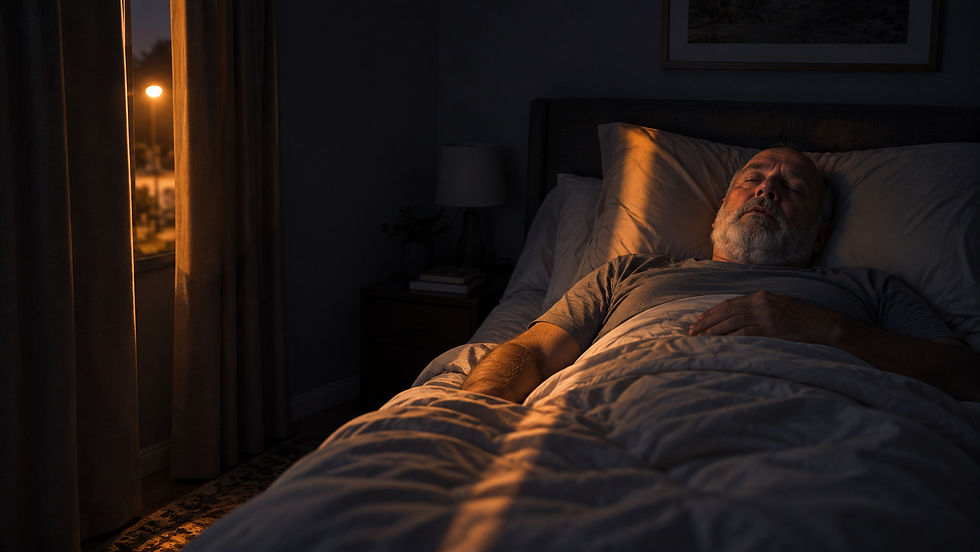
If you fall asleep with the TV on, keep your phone face-up on the nightstand, or live on a street where the lamp outside shines straight into the bedroom, a study published this week has your name on it.
Researchers put light sensors on the wrists of more than 11,000 adults, waited three years, and then scanned their hearts with MRI. People who had more light at night — and we are talking about very dim light, less than a night-light — had hearts that were measurably thicker and stiffer. Over the following decade, the same kind of exposure was tied to more heart failure, more atrial fibrillation, more heart attacks, and more strokes.
That's the headline. It's accurate. But "your bedroom is giving you heart disease" is not what the study showed, and the difference matters for what you should actually do about it.
What happened
On September 10, the European Heart Journal published a study led by Professor Lu Qi at Tulane University in New Orleans. It used the UK Biobank, one of the largest health databases in the world.
Between 2013 and 2015, 11,071 adults (average age 61, 57% women, no known heart disease) wore a wrist device for seven days that recorded both movement and ambient light. About three years later, each of them had a cardiac MRI, the most precise way to measure the size, wall thickness, and pumping mechanics of the heart.
The researchers focused on one number: how many minutes per night the sensor recorded light above 3 lux. Three lux is dim. A full moon on a clear night gives you well under one lux. A streetlight through a thin curtain, a phone screen glowing on the nightstand, a TV left on across the room, or a standard plug-in night-light can all push a bedroom past three. Three lux is roughly the level at which the brain starts to suppress melatonin, the hormone that signals "it's night."
About a quarter of participants had essentially zero light above that threshold. The rest were split into low, intermediate, and high groups. The "high" group averaged about 34 minutes a night above 3 lux. That is not sleeping under a chandelier. It's a fairly ordinary modern bedroom.
What the MRIs showed
Compared with people who slept in near-total darkness, people in the high-exposure group had, on average:
2.4% more left ventricular muscle mass and 1.5% thicker heart walls. The pattern (thicker walls, no change in the shape ratio) is what cardiologists call concentric hypertrophy, the same remodeling seen with long-standing high blood pressure.
About 2% lower myocardial contraction fraction, and 2.7% to 2.9% less "strain," which is a measure of how well the heart muscle deforms and flexes with each beat. These are early markers of stiffness, the kind that show up years before anyone feels short of breath.
A slightly larger left atrium with slightly weaker emptying, a pattern linked to atrial fibrillation risk.
Every one of these changes got worse in a straight line as nighttime light went up. There was no threshold below which the association disappeared.
The study also looked at roughly 73,000 UK Biobank participants with wrist-sensor data and followed them for 8 to 10 years. Compared with the darkest sleepers, the highest-exposure group had a 29% higher risk of heart failure, 15% higher risk of atrial fibrillation, 24% higher risk of heart attack, 33% higher risk of stroke, and 26% higher risk of dying from cardiovascular causes.
Those are relative increases, after statistical adjustment for age, sex, income, education, smoking, alcohol, diet, physical activity, BMI, blood pressure, cholesterol, diabetes, kidney function, vitamin D, air pollution, season, and daytime light exposure.

How to read those numbers
This is where a careful reader slows down.
First, the individual heart changes are small. A 2.4% difference in heart muscle mass is real and statistically solid in a group of 11,000, but it's not something you would notice on your own echocardiogram, and it is not a diagnosis. The significance is in the direction and the consistency: multiple chambers, multiple measurements, all pointing the same way, all dose-dependent. That's what makes researchers take it seriously.
Second, this is an observational study. It can show that light at night and heart changes travel together. It cannot prove that one causes the other. The researchers adjusted for an unusually long list of factors, but no adjustment is perfect. People whose bedrooms are lit at 2 AM are often people who are awake at 2 AM — because of insomnia, pain, a baby, needing to urinate, sleep apnea, or a night job. Some of those are independently hard on the heart.
Third, the light was measured at the wrist, not at the eyes. If your arm was under the blanket, the sensor read darker than your face experienced. If your arm was outside, it may have read brighter. This adds noise, and noise usually weakens associations rather than creating them, but it's a limitation worth knowing.
Fourth, the study population was 98% white, British, and between roughly 45 and 75 at the time of the sensor recording. Night-shift workers were deliberately excluded, because the method for identifying "night" doesn't work for them. So this study says nothing directly about people who work overnight, even though shift work has its own well-documented cardiovascular risk.
Fifth, and this is the interesting part: the researchers tested whether shorter sleep explained the link. It explained some of it, roughly a quarter to a half depending on the measurement, but not all. Something beyond simply "light keeps you up" seems to be going on. The leading theory is circadian disruption: light at the wrong time confuses the body's internal clock, which regulates blood pressure, heart rate, and how heart muscle uses energy over 24 hours.
Why this isn't just one study
If this were a single surprising finding, the right response would be interest and patience. It isn't.
In October 2025, a separate team published a study in JAMA Network Open using the same UK Biobank light-sensor data but a different question: not heart structure, but actual disease. Following 88,905 adults for about 9.5 years, they found that the brightest-night sleepers had a 23% to 32% higher risk of coronary artery disease and a 45% to 56% higher risk of heart failure compared with the darkest sleepers. The new study essentially fills in the mechanism between exposure and outcome.
And there is experimental evidence, which observational studies can't provide. In a small 2022 study published in PNAS, healthy young adults spent one night sleeping in a room lit to about 100 lux (ordinary dim room light) versus under 3 lux. After the lit night, their heart rate stayed higher through sleep, they spent less time in deep sleep, and their insulin sensitivity the next morning was measurably worse. One night. That's a plausibility check: the body does respond to light during sleep, and the response involves the cardiovascular and metabolic systems.
The American Heart Association has already flagged circadian health, including nighttime light, as a research priority in a scientific statement. The editorial accompanying the new study, from Professor Thomas Münzel in Mainz, went further and argued that clinicians, especially those treating heart failure and atrial fibrillation patients, should start asking about the sleep environment the way they ask about salt and smoking.

What's still unknown
Nobody has run the trial that would settle this: randomly assign people to blackout curtains versus their usual bedroom for years and count heart attacks. That trial may never happen. So the honest statement is: nighttime light is a probable contributor to cardiovascular risk, with consistent observational evidence, a biological mechanism, and short-term experimental support, but no proof that fixing it prevents disease.
We also don't know how much light is "safe," whether the color of light matters as much in real bedrooms as it does in the lab, or whether the effect is the same for someone who is 35 as for someone who is 65.
What we do know is that the intervention costs almost nothing and has no downside. That changes the calculation. You don't need certainty to justify closing the curtains.
What's worth doing
The practical advice from the editorial is simple, and it matches what sleep medicine has recommended for years.
Make the bedroom as dark as you reasonably can. Blackout curtains or a blackout liner behind the curtains you already have. If that's not possible, a sleep mask does the same job for a few dollars.
Take the phone out of the sleep equation. Face-down, or better, across the room. Notifications light the screen even when you don't touch it.
Turn the TV off, or set a sleep timer so it turns itself off after you drift off. Falling asleep to the TV is one of the most common habits in our community, and it's one of the easiest sources of exactly the kind of low-level, hours-long light this study measured.
Cover or unplug the small standby LEDs on chargers, TVs, routers, and air purifiers. A piece of electrical tape works.
If you need a night-light for safety — for an older parent, a child, or to find the bathroom — use a dim, warm-colored (amber or red) one, placed low, ideally motion-activated so it's only on when someone is moving.
Get bright light in the morning. This study found no harm from daytime light, and the 2025 study found daytime light was protective. Morning daylight strengthens the circadian rhythm that nighttime light weakens.
Who should pay particular attention?
If you already have high blood pressure, atrial fibrillation, heart failure, diabetes, or sleep apnea, your heart is already under the kind of chronic stress this remodeling reflects. A dark bedroom is not a treatment for any of those, but it removes one more load.
If you are up at night a lot, that's the more important signal. Frequent nighttime urination, waking unrefreshed, snoring, or lying awake for an hour at 3 AM are each worth a conversation, because the causes (sleep apnea, uncontrolled blood pressure, prostate enlargement, poorly controlled diabetes, anxiety) matter far more than the lamp you turn on when you get up.
If you work nights, this study can't tell you much, but the broader literature is clear enough: protect your daytime sleep with true darkness, and make sure your blood pressure and metabolic labs are checked regularly.
When to get evaluated
None of this requires an urgent visit. But if you notice new shortness of breath with ordinary activity, swelling in your ankles, a racing or irregular heartbeat, or you wake up at night gasping or unable to lie flat, those are symptoms of the conditions this study was tracking, and they need evaluation, not a new set of curtains.
If you simply want to know where you stand, a blood pressure check, a basic metabolic panel, a lipid panel, and a 30-year cardiovascular risk estimate are a reasonable starting point at any age over 30. We offer all of these through a telehealth visit, and our free heart-risk calculator and insomnia self-assessment on the Patient Tools page can help you decide whether a visit makes sense.
The takeaway
A dark bedroom used to be a comfort preference. The evidence is now strong enough to call it a cardiovascular habit, in the same category as walking, sleeping enough, and not smoking. Not the biggest factor. But one of the cheapest ones to fix.
Tonight: curtains closed, phone off the nightstand, TV timer set. Your heart will not thank you by tomorrow. But the MRIs suggest it may in ten years.
Sources
Dai J, et al. Nighttime light exposure and cardiac structure and function. European Heart Journal, published online 10 September 2026. doi:10.1093/eurheartj/ehag563
Münzel T, et al. The dark night as a cardiovascular vital sign: personal light exposure, subclinical cardiac remodelling, and the urban exposome. European Heart Journal, 2026 (editorial). doi:10.1093/eurheartj/ehag650
European Society of Cardiology press release, 10 September 2026: "Too much light at night changes the shape and working of the heart."
Windred DP, et al. Light Exposure at Night and Cardiovascular Disease Incidence. JAMA Network Open, 23 October 2025.
Mason IC, et al. Light exposure during sleep impairs cardiometabolic function. PNAS, 2022;119(12):e2113290119.
American Heart Association scientific statement on circadian health and cardiovascular disease (referenced in Dai et al., 2026).
This article is for general education and does not replace an individual medical evaluation.


Comments