
Is There a Blood Test for Alzheimer’s? What It Shows — and the Labs to Check First

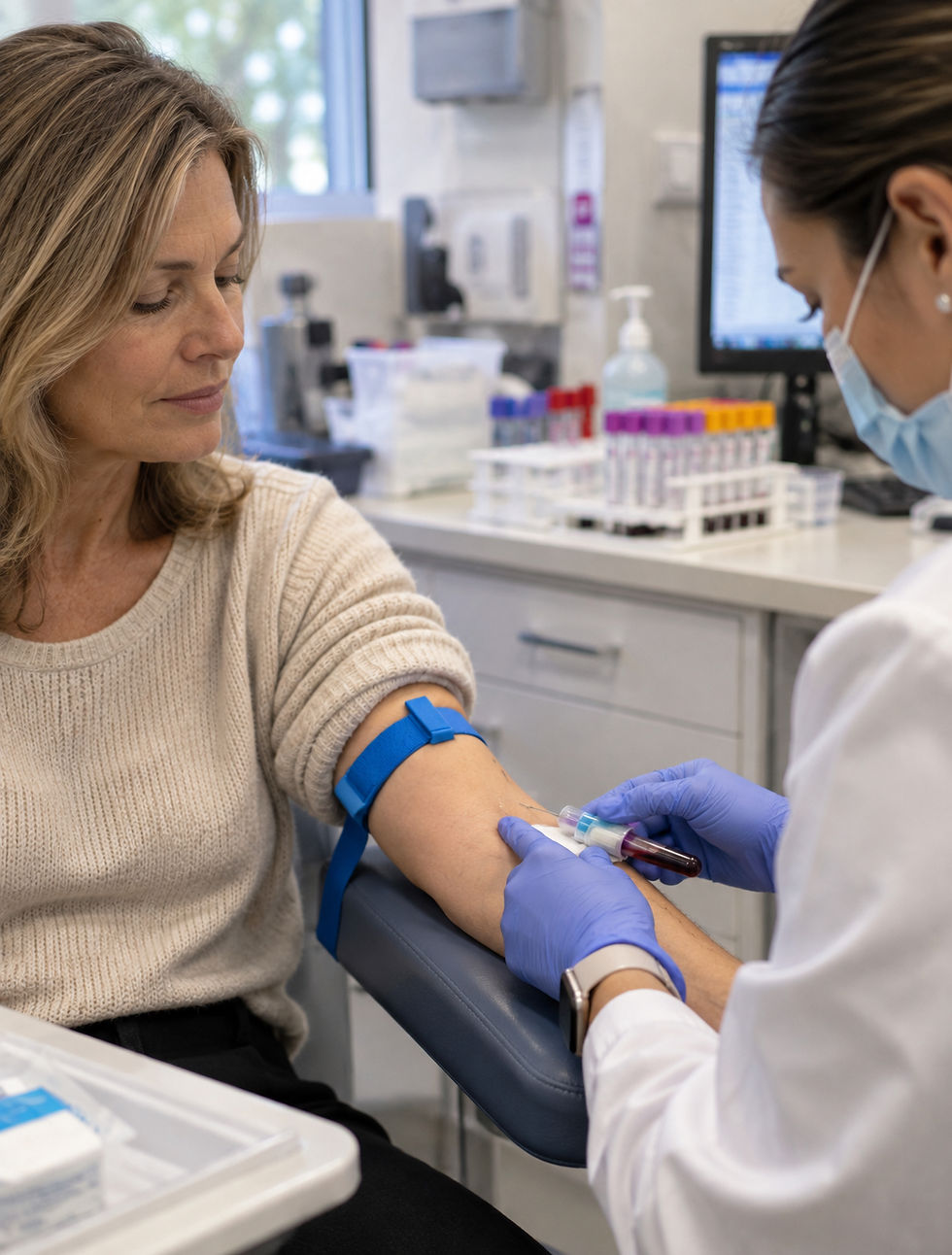
Maybe your mom has told you the same story twice in one afternoon. Maybe you’ve walked into the kitchen and completely forgotten why. Either way, you’ve probably seen the headlines: there’s now a blood test for Alzheimer’s disease.
That’s true, and it’s real progress. But the test isn’t quite what most people imagine, and it’s not where a memory evaluation should start.
What changed
For decades, the only way to see the brain changes of Alzheimer’s in a living person was an amyloid PET scan or a lumbar puncture (a spinal tap). Both are expensive, hard to get, and not pleasant.
Since 2025, the FDA has cleared four blood tests that look for the same changes:
Lumipulse (Fujirebio) — May 2025, the first one
Elecsys pTau181 (Roche) — October 2025, mainly to help primary care rule out Alzheimer’s
PrecivityAD2 (C2N) — August 2026, the first cleared for adults as young as 40
Elecsys pTau217 (Roche) — August 2026, can help both rule Alzheimer’s in and rule it out, in primary and specialty care
What the test actually looks for

Alzheimer’s is linked to two proteins that build up in the brain: amyloid, which forms plaques between nerve cells, and tau, which forms tangles inside them. Tiny amounts of certain forms of these proteins leak into the blood. The tests measure them — markers like pTau217 and amyloid-beta — and estimate how likely it is that amyloid plaques are present in the brain.
Results usually come back as negative, intermediate, or positive. An intermediate result means more testing is needed.
Who it’s for — and who it isn’t
This is the part most headlines skip. All four tests are cleared only for people who already have memory or thinking symptoms — generally age 55 and older (one test from age 40). None of them is a screening test for healthy people.
There are good reasons for that:
Amyloid can build up for years before any symptoms, and not everyone with amyloid develops dementia. A positive result in someone who feels fine doesn’t come with a clear plan.
In people with a low chance of having Alzheimer’s, false positives become more likely.
Kidney disease can raise these blood markers, which is one more reason results have to be read alongside other labs.
The Alzheimer’s Association’s guideline is clear: these tests don’t replace a full evaluation, and they shouldn’t be ordered before one.
Before any Alzheimer’s test: check what’s treatable
Memory problems have many causes, and some of them are very fixable. That’s why a good evaluation starts with the basics:
Low vitamin B12 — common with age, metformin, and long-term heartburn medicines
An underactive thyroid (hypothyroidism)
Depression and anxiety — they can look a lot like memory loss
Poor sleep and sleep apnea
Hearing loss
Medications — more on these below
How some medicines can dull memory
These medicines are common, and many people take them for years without anyone connecting them to memory problems. The good news: when a medicine is the cause, memory often improves after it’s changed or tapered. The effect gets stronger with age, because an older liver and kidneys clear drugs more slowly, so they build up.
Benzodiazepines — alprazolam (Xanax), lorazepam (Ativan), clonazepam (Klonopin), diazepam (Valium). These calm anxiety by pressing the brain’s “brake pedal.” That same brake slows the brain’s ability to store new memories, which is why people on them may not remember a conversation or where they put things. In older adults they also cause confusion, unsteadiness and falls.
Sleeping pills — zolpidem (Ambien), eszopiclone (Lunesta), and “PM” products such as Tylenol PM, Advil PM, ZzzQuil or Unisom. Prescription sleeping pills work on the same brake as benzodiazepines. They can cause next-morning grogginess, memory gaps, and sometimes doing things at night with no memory of them. Most over-the-counter “PM” products contain diphenhydramine or doxylamine, which work like the allergy medicines below.
Older allergy medicines and some bladder medicines — diphenhydramine (Benadryl), chlorpheniramine, hydroxyzine; oxybutynin (Ditropan), tolterodine (Detrol). These block acetylcholine, a chemical messenger the brain needs for memory and attention. It’s the same messenger that Alzheimer’s medicines like donepezil try to boost, so these drugs work in the opposite direction. Newer options, such as loratadine (Claritin) or fexofenadine (Allegra) for allergies and mirabegron (Myrbetriq) for bladder symptoms, affect the brain much less.

Corvalol and Valocordin — many families bring these from home “for the heart” or “for nerves.” Both contain phenobarbital, a barbiturate — an old, strong sedative. Phenobarbital leaves the body very slowly, so with daily drops it builds up. Both also contain a bromine compound that can accumulate too and cause drowsiness, confusion and unsteady walking. In the U.S., phenobarbital is available only by prescription.
Important: don’t stop any of these on your own. After regular use, stopping benzodiazepines, sleeping pills or Corvalol suddenly can cause withdrawal, and in rare cases seizures. Bring every bottle to your visit, including drops and pills from abroad, and we’ll work out a safe plan together.

The labs we start with
CBC (complete blood count) — anemia and infection
CMP (comprehensive metabolic panel) — sodium, calcium, blood sugar, kidney and liver function
TSH — thyroid function
Vitamin B12 (+ methylmalonic acid if borderline) — B12 deficiency
Hemoglobin A1c — long-term blood sugar
Lipid panel — cholesterol and blood-vessel risk
Depending on your history, we may add tests for syphilis, HIV, or folate.
What we don’t order routinely, and why: APOE gene testing (it doesn’t diagnose Alzheimer’s), vitamin D “for memory,” homocysteine, or heavy-metal panels without a specific exposure. None of these has been shown to change outcomes when checked routinely.
Besides labs, a proper evaluation includes a short memory test, a mood check, a look at sleep and hearing, and often a brain MRI.
Normal aging or worth a visit?
[

Usually normal: forgetting a name and remembering it later, occasionally misplacing keys, needing a moment to find a word.
Worth a visit: asking the same questions again and again, getting lost somewhere familiar, trouble with bills or medications, missing appointments that used to be routine, or personality changes that family notices.
What happens next
A visit to talk through symptoms and review every medication
Basic labs and a short memory test
A brain MRI when needed
If the picture points toward Alzheimer’s, a blood biomarker test
What if the result is positive?

A positive blood test doesn’t mean “you have Alzheimer’s, end of story.” It’s one piece of the picture, and the next step is a neurologist. They confirm the diagnosis, work out the stage, and usually order a brain MRI.
Newer medicines. If Alzheimer’s is confirmed early — at the stage of mild cognitive impairment or mild dementia — there are two approved medicines: lecanemab (Leqembi) and donanemab (Kisunla). They target amyloid, the protein that builds up in the brain. They don’t cure the disease or bring memory back. In studies they slowed decline modestly, and they require regular MRI checks because of a risk of brain swelling or small bleeds.
Older medicines. These have been used for more than 20 years. They don’t slow the disease itself, but they can help with symptoms for a while:
Donepezil (Aricept), rivastigmine (Exelon — pills or a skin patch), and galantamine (Razadyne). They raise the level of acetylcholine, a chemical nerve cells use to pass messages. They’re used in mild to moderate Alzheimer’s; donepezil is also used in severe disease. Some people think more clearly or manage daily tasks a bit better; others notice little change. On average the effect is small, so it’s worth reassessing after a few months. Common side effects are nausea, diarrhea, poor appetite and vivid dreams; less often, a slow heart rate or dizziness. The patch usually upsets the stomach less.
Memantine (Namenda). It works differently, by calming overactive signaling between nerve cells. It’s used in moderate to severe Alzheimer’s, often together with donepezil (there is also a combination capsule, Namzaric). It can help with daily function and thinking. Side effects are usually mild: dizziness, headache, constipation.
These medicines aren’t proven to help at the earliest stage, mild cognitive impairment, so they’re not automatically started there.
Treating blood pressure, blood sugar, hearing loss, sleep and mood still matters, and so does staying physically and socially active.
Just as important is planning while decisions are still easy to make together: finances, driving, and who will speak for you if you can’t.
A positive result can also affect long-term-care or life insurance applications. That’s one reason to talk through the test with your clinician before you take it.
The bottom line
The new blood tests are a real step forward: faster answers, fewer spinal taps, less waiting. But they’re for people who already have symptoms, and they come after the basics — not instead of them.
If you’ve noticed changes in yourself or someone you love, don’t wait and don’t guess. Start with a visit and basic labs. Before your appointment, you can take our free depression and anxiety screen (PHQ-9/GAD-7) or the Insomnia Assessment on our Patient Tools page. We see patients in English, Ukrainian, and Russian.
How we wrote this: every claim is traced to FDA clearances and labels, clinical practice guidelines, and the sources listed below.
Sources
Alzheimer’s Association Clinical Practice Guideline on blood-based biomarkers (Alzheimer’s & Dementia, 2025) — alz.org/alz-pro/hub/care-pathway/blood-based-biomarkers-guideline
Alzheimer’s Association statement on Elecsys pTau217 (Aug 24, 2026) — alz.org/news/2026/fda-clearance-elecsys-ptau217-blood-test-alzheimers
Alzheimer’s Association statement on PrecivityAD2 (Aug 20, 2026) — alz.org/news/2026/fda-clearance-precivityad2-blood-test-alzheimers
Lumipulse FDA clearance review (2025) — pubmed.ncbi.nlm.nih.gov/40582836
Alzheimer’s Association, Lecanemab (Leqembi) — alz.org/alzheimers-dementia/treatments/lecanemab-leqembi
American Geriatrics Society 2023 Updated Beers Criteria (J Am Geriatr Soc, 2023)
American Academy of Neurology practice guideline update: mild cognitive impairment (Neurology, 2018)



Comments